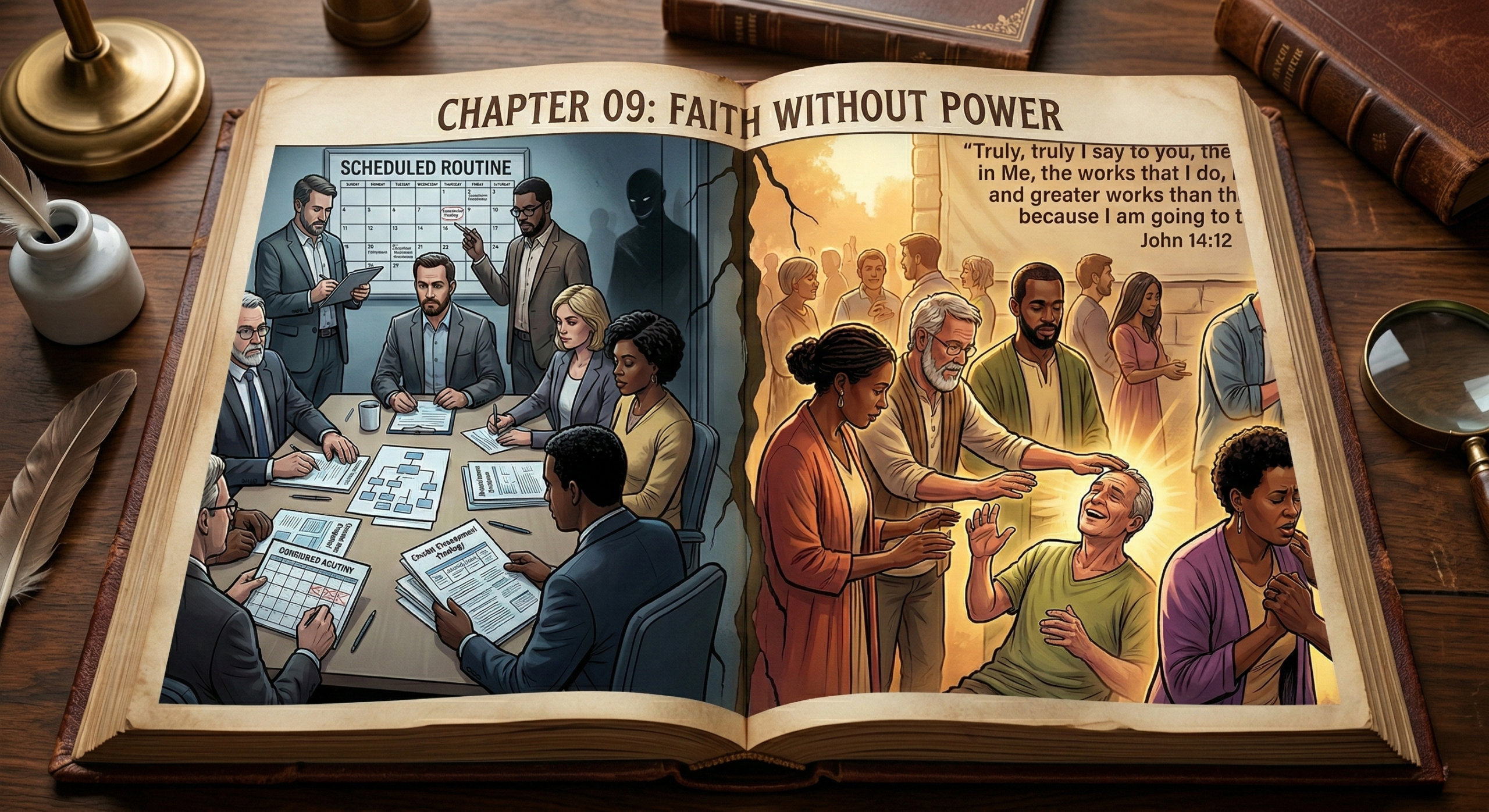
Chapter 09 – Faith Without Power
Truly, truly I say to you, the one who believes in Me, the works that I do, he will do also; and greater works than these he will do; because I am going to the Father.
John 14:12 (NASB)
The Unnatural Faith
Satan has convinced much of the modern Western church that God works primarily through natural means, that expecting supernatural intervention is presumptuous, immature, or even dangerous. This deception transforms the church from a supernatural force that demonstrates God’s kingdom into a merely human organization that talks about a God who once acted powerfully but now seems to prefer working through natural processes.
The enemy whispers that miracles were for biblical times, that spiritual gifts ceased with the apostles, that expecting God to heal, deliver, or speak directly today is naive at best and delusional at worst. He has successfully replaced supernatural expectation with human programs, divine power with institutional management, and the movement of the Spirit with the safety of predictable routine.
The irony of course is that a faith stripped of the supernatural becomes unnatural. Faith in Jesus Christ, by its very nature, is grounded in the most supernatural event in history, the death and resurrection of Jesus. A God who speaks creation into existence, parts seas, raises the dead, and conquers the grave doesn’t suddenly become a God who works only through doctors, committees, and programs. A truly natural faith, one that aligns with the nature of our God, must be supernatural. Anything less isn’t merely incomplete; it is a distortion of what God intended for His church.
When Power Was Normal
Throughout Scripture, the supernatural wasn’t extraordinary; it was the expected evidence of God’s presence among His people.
In the Old Testament, God’s people witnessed His power regularly. Moses didn’t just teach about God; he stretched out his staff and the Red Sea parted (Exodus 14:16, 21-22). Elijah didn’t merely preach about provision; he watched oil and flour multiply during famine (1 Kings 17:14-16). Elisha didn’t just comfort the sick; he healed leprosy with a word (2 Kings 5:10-14). Daniel didn’t simply trust God intellectually; he walked unharmed from a den of lions (Daniel 6:21-22).
These weren’t spiritual superheroes with abilities beyond normal believers. They were ordinary people who served an extraordinary God, people who expected Him to act and positioned themselves to be vessels for His power. The supernatural validated their message, demonstrated God’s presence, and drew people to worship.
When Jesus arrived, He didn’t diminish this expectation, He amplified it. He healed many diseases brought to Him, though Scripture also records times when He “could not do many miracles” because of unbelief (Mark 6:5-6). He cast out demons with a word. He multiplied food, walked on water, and raised the dead. More remarkably, He promised His followers would do similar works:
Heal the sick, raise the dead, cleanse those with leprosy, cast out demons. Freely you received, freely give.
Matthew 10:8 (NASB)
The book of Acts shows this wasn’t hyperbole. Ordinary believers, not just apostles, healed the sick, prophesied, cast out demons, and saw visions. Philip, appointed to wait tables, performed signs and wonders in Samaria (Acts 6:2-5, 8:5-7). Ananias, described simply as “a disciple,” healed Paul’s blindness (Acts 9:10-18). The supernatural was so normal that Paul had to give guidelines for orderly expression of spiritual gifts, not arguments for their existence.
The Great Decline
How did we get from there to here? How did the church that turned the world upside down through supernatural demonstration become an institution that primarily offers programs, talks, and activities barely distinguishable from secular organizations?
The decline began subtly. As Christianity gained respectability in the Roman Empire, the need for supernatural validation seemed less urgent. When Constantine legalized Christianity, the church shifted from desperate dependence on God’s power to comfortable reliance on political favor. Why risk praying for miraculous provision when the empire provides funding? Why seek divine healing when you have access to the best physicians?
The Enlightenment accelerated this shift. As human reason was exalted and science explained more natural phenomena, the supernatural became embarrassing to educated Christians. Miracles weren’t denied outright (that would be heresy) but they were safely relegated to biblical times or foreign missions. The Western church developed elaborate theological systems to explain why God, though theoretically capable of miracles, chose not to perform them anymore.
The Reformers, reacting against Catholic claims of miracles through relics and saints, often threw out the supernatural baby with the superstitious bathwater. Many Protestant traditions developed cessationist theology, the belief that miraculous gifts ended with the apostolic age. Cessationists point to passages like 1 Corinthians 13:8-10, interpreting “the perfect” as the completion of the Bible:
Love never fails; but if there are gifts of prophecy, they will be done away with; if there are tongues, they will cease; if there is knowledge, it will be done away with. For we know in part and prophesy in part; but when the perfect comes, the partial will be done away with.
1 Corinthians 13:8-10 (NASB)
However, this interpretation faces significant challenges. The context suggests Paul refers to Christ’s return, not a completed canon. Nowhere does Scripture explicitly state that gifts would cease before then. While sincere believers hold cessationist views, the biblical case for ongoing spiritual gifts remains stronger.
Modern seminaries often treat the supernatural as a historical curiosity rather than present reality. Pastors are trained in counseling, administration, and hermeneutics, but rarely in healing, deliverance, or prophecy. Churches invest millions in buildings, programs, and technology while prayer meetings, where supernatural breakthrough often occurs, attract only a faithful few.
The Comfort That Kills Power
The Western church’s material comfort has become spiritual kryptonite. When every need can be met through human means, dependence on divine intervention atrophies. Consider the pattern: Christianity explodes with supernatural power in regions marked by persecution, poverty, and desperation, while it often declines into powerless respectability in comfortable, affluent areas.
We pray for the sick, certainly, but often with more faith in medicine than miracles. This isn’t to diminish medicine; Luke was a physician, and God often works through medical professionals. But when medicine becomes our only expectation, when we can’t imagine God healing apart from doctors, we have lost something vital. We acknowledge spiritual oppression exists but reach first for counseling rather than deliverance. Again, counseling has its place, the mind and emotions need care, but not every problem is psychological. We make decisions through careful planning and consensus rather than seeking God’s direct guidance, forgetting that the early church made major decisions through prophecy and dreams (Acts 13:2, 16:9-10).
The tragedy is that we have adjusted our theology to match our limited experience rather than pursuing the fuller experience Scripture describes. When we see few miracles, we conclude they’re rare rather than examining our faith. When spiritual gifts seem absent, we question their validity rather than our receptivity. Instead of pressing in with greater hunger when God seems distant, we have settled for explanations that excuse our powerlessness.
The Cost of Powerlessness
This powerlessness deception costs more than we realize. When the church operates purely through human means, we offer the world nothing it can’t get elsewhere; and often with better production values.
People struggling with addiction find twelve-step programs as effective as church programs. Those seeking community find it in clubs and causes. Those wanting moral teaching can find it in philosophy and self-help. When the church offers only what human effort can produce, why would anyone rearrange their life around faith?
Powerlessness leaves people in bondage who should be free. How many remain sick because we have stopped believing God heals? How many stay oppressed because we no longer practice deliverance? How many lack direction because we have silenced prophecy? How many seekers turn away because they see no evidence of supernatural reality?
Paul said, “My message and my preaching were not in persuasive words of wisdom, but in demonstration of the Spirit and of power” (1 Corinthians 2:4). When we offer words without power, we’re not fully presenting the kingdom. We’re giving people religion (rules, rituals, and rhetoric) without the transforming encounter with the living God that changes everything.
The Mystery of Suffering
Any honest discussion of supernatural faith must address the mystery of unanswered prayer and persistent suffering. Even in Scripture, not everyone was healed. Paul left Trophimus sick in Miletus (2 Timothy 4:20). Timothy had chronic stomach problems (1 Timothy 5:23).
These realities don’t negate God’s power, they remind us of His sovereignty. We operate in the tension between “already” and “not yet,” between the kingdom breaking in and its final consummation. Sometimes God’s “no” or “wait” serves purposes we cannot see. Sometimes suffering produces character, dependence, or testimony that healing wouldn’t achieve. As Paul learned, God’s grace can be sufficient even when the thorn remains.
This mystery, however, shouldn’t become an excuse for unbelief. Too often, we use God’s sovereignty to justify our lack of faith. We pray with so many disclaimers that we’re essentially telling God we don’t expect Him to act. While maintaining humility about outcomes, we can still pray with bold faith, knowing that God delights to demonstrate His power and compassion.
Reclaiming Biblical Expectation
Breaking free from the powerlessness deception doesn’t mean embracing chaos or gullibility. It means returning to scriptural normalcy; expecting God to act supernaturally while exercising wisdom and discernment.
Start by examining your theology. Does it come from Scripture or from experience (or lack thereof)? The Scriptures present supernatural ministry as normal for believers, not exceptional. Jesus’s promise about “greater works” (John 14:12) likely refers to the global scope of the gospel through the church, but it certainly doesn’t suggest lesser works or no works at all.
Begin expecting God to move supernaturally. When someone is sick, pray for healing with genuine faith while also supporting medical treatment. God often works through both supernatural and natural means, they’re not in competition. Approach Him with the confidence of a child who knows their Father’s character, while acknowledging His wisdom surpasses ours. Pray with authority over sickness, knowing that the same Spirit who raised Christ from the dead dwells in you (Romans 8:11). When healing doesn’t come immediately, don’t automatically lower your expectations but also don’t heap guilt on the suffering. Sometimes we need to press in harder; sometimes we need to rest in God’s mysterious purposes.
Pursue spiritual gifts actively. Paul commands us to “earnestly desire spiritual gifts” (1 Corinthians 14:1). This isn’t optional or for special Christians. Every believer has access to gifts of the Spirit for the common good. Ask God what gifts He wants to develop in you. Practice hearing His voice. Step out in faith when He prompts you to pray for someone or share a word of encouragement. But always test everything against Scripture and in community with other believers.
Dealing with Disappointment
The path back to supernatural normalcy includes disappointment. Not every prayer for healing sees immediate results. Not every prophetic word proves accurate.1 Not every attempt at deliverance brings freedom. This reality stops many from even trying, but it shouldn’t.
Jesus’s disciples experienced failure too. They couldn’t cast out a demon and had to ask Jesus why (Matthew 17:19). Rather than telling them to stop trying, He instructed them about faith and fasting. Failure isn’t proof that God doesn’t work supernaturally, it is part of learning to cooperate with Him.
When prayers seem unanswered, resist both extremes: don’t lower expectations to avoid disappointment, but don’t assume the problem is always lack of faith. Sometimes there are spiritual obstacles to address. Sometimes God’s timing differs from ours. Sometimes His purposes involve outcomes we wouldn’t choose but that serve a greater good we cannot see. When we are confused about God’s plan, seek discernment instead of despair.
Remember that biblical faith perseveres through disappointment without becoming cynical. Job declared, “Though He slay me, I will hope in Him.” (Job 13:15). This isn’t fatalism but mature faith that trusts God’s character even when His ways are mysterious.
Discerning the Genuine
Pursuing the supernatural requires discernment. Not everything claimed as miraculous is genuine. Scripture warns about false signs and wonders (Matthew 24:24) and commands us to test the spirits (1 John 4:1).
True supernatural ministry always points to Jesus, not the minister. It produces fruit consistent with the Spirit: love, joy, peace, patience, kindness, goodness, faithfulness, gentleness, and self-control (Galatians 5:22-23). It aligns with Scripture’s teaching and submits to biblical authority. It builds up the body of Christ rather than creating division or drawing attention to individuals.
Be wary of those who merchandise the miraculous, who make supernatural ministry about money, manipulation, or personal glory. The genuine supernatural is marked by humility, service, and pointing people to Christ. It builds up the body rather than creating personality cults. True prophecy can be tested and weighed (1 Corinthians 14:29). True healing results in genuine, verifiable change. True deliverance produces lasting freedom and spiritual fruit.
At the same time, don’t let fear of deception keep you from pursuing the genuine. The existence of counterfeit money doesn’t mean we stop using real currency. The presence of false miracles doesn’t negate authentic ones. Learn to discern without becoming cynical.
The Return to Power
The Western church stands at a crossroads. We can continue down the path of powerless respectability, offering the world nothing it can’t find elsewhere. Or we can humble ourselves, acknowledge our shortcomings, and desperately seek God for the supernatural demonstration He promises.
This isn’t about sensationalism or showing off. It is about being the church Jesus intended; a body that doesn’t just talk about God’s power but demonstrates it. A community where the sick find healing, the oppressed find freedom, the lost receive divine revelation, and the hopeless encounter undeniable evidence that God is real and active.
The world is desperate for authentic supernatural reality. New Age practices, occult involvement, and fascination with the paranormal reveal humanity’s hunger for something beyond the material. When the church fails to provide genuine supernatural encounter with God, people seek counterfeits elsewhere.
Power for a Purpose
The powerlessness deception hasn’t just robbed the church of excitement or experiences. It is robbed us of our essential identity as people who demonstrate the kingdom of God. Jesus didn’t say the kingdom comes through excellent programs or convincing arguments but through power (1 Corinthians 4:20).
This power isn’t for our entertainment or ego. It is for the advancement of the gospel, the freedom of captives, the healing of the broken, and the glory of God. When the church operates in supernatural power, we become undeniable evidence that God is real, present, and active.
The promise remains: believers will participate in the works Jesus did. Not because we’re special but because the same Spirit who empowered Him lives in us. The question isn’t whether God still works supernaturally; Scripture and global Christian experience confirm He does. The question is whether we’ll break free from the powerlessness deception and become vessels for His power again.
Reflections
Power Expectation: What supernatural works do you genuinely expect God to do through you? How does this compare to what Scripture presents as normal for believers?
Comfort Analysis: How has material comfort and self-sufficiency reduced your dependence on God’s supernatural intervention? Where do you default to human solutions without seeking divine input?
Theological Integrity: Have you developed theology to explain away lack of experience rather than pursuing the experience Scripture describes? What biblical promises have you explained away?
Faith Action: What specific step of supernatural faith will you take this week? Will you pray for someone’s healing? Listen for God’s voice? Ask for spiritual gifts? Step out in prophecy?
Mystery Management: How do you handle the tension between God’s sovereignty and His promises of power? Can you maintain faith through disappointment without becoming either presumptuous or cynical?
A Prayer for Us
Heavenly Father,
Forgive us for accepting powerlessness as normal when You promised supernatural demonstration. We have traded Your power for programs, Your presence for presentations, Your miracles for management. We have created theological systems to excuse our unbelief rather than pressing in for the faith You desire.
Lord Jesus, You healed the sick, cast out demons, and raised the dead. You promised Your followers would participate in similar works through Your Spirit. Yet we have explained away Your promises, limited Your power to biblical times, and settled for a form of godliness that denies its power.
Break the powerlessness deception over our lives. Shatter both the unbelief that expects nothing and the presumption that demands everything. Give us mature faith that trusts Your sovereignty while expecting Your intervention, that perseveres through disappointment without becoming cynical.
Holy Spirit, You who distribute gifts as You will, awaken the supernatural in us. Give us gifts that serve the body and glorify Christ. Teach us to hear Your voice clearly, test everything carefully, and respond obediently. Make us vessels for Your power and train us to use it while keeping us humble and dependent.
When disappointment comes, guard us from both extremes; don’t let us lower our expectations to avoid pain, but don’t let us heap condemnation on ourselves or others. When sickness persists despite prayer, when prophecy seems silent, when deliverance doesn’t come, teach us to trust Your purposes while maintaining faith for breakthrough.
Give us wisdom to discern the genuine from the counterfeit, to embrace the authentic while rejecting the false. Protect us from those who merchandise the miraculous and from becoming those who do so. Keep our focus on Jesus, not on signs and wonders.
Raise up a generation that refuses powerless Christianity while maintaining biblical balance. May we see authentic healings that point to You, genuine prophecy that builds up the body, real deliverance that produces lasting freedom, and demonstrations of Your Spirit that draw people to Christ.
In the name of Jesus, who still works through Your people for Your glory, Amen.
1 In both the Old and New Testaments, prophecy is presented as a weighty and dangerous calling. In the Old Testament, the penalty for false prophecy was death (Deuteronomy 18:20-22). The New Testament also repeatedly warns believers to beware of false prophets (Matthew 7:15; 24:24; 1 John 4:1; 2 Peter 2:1).