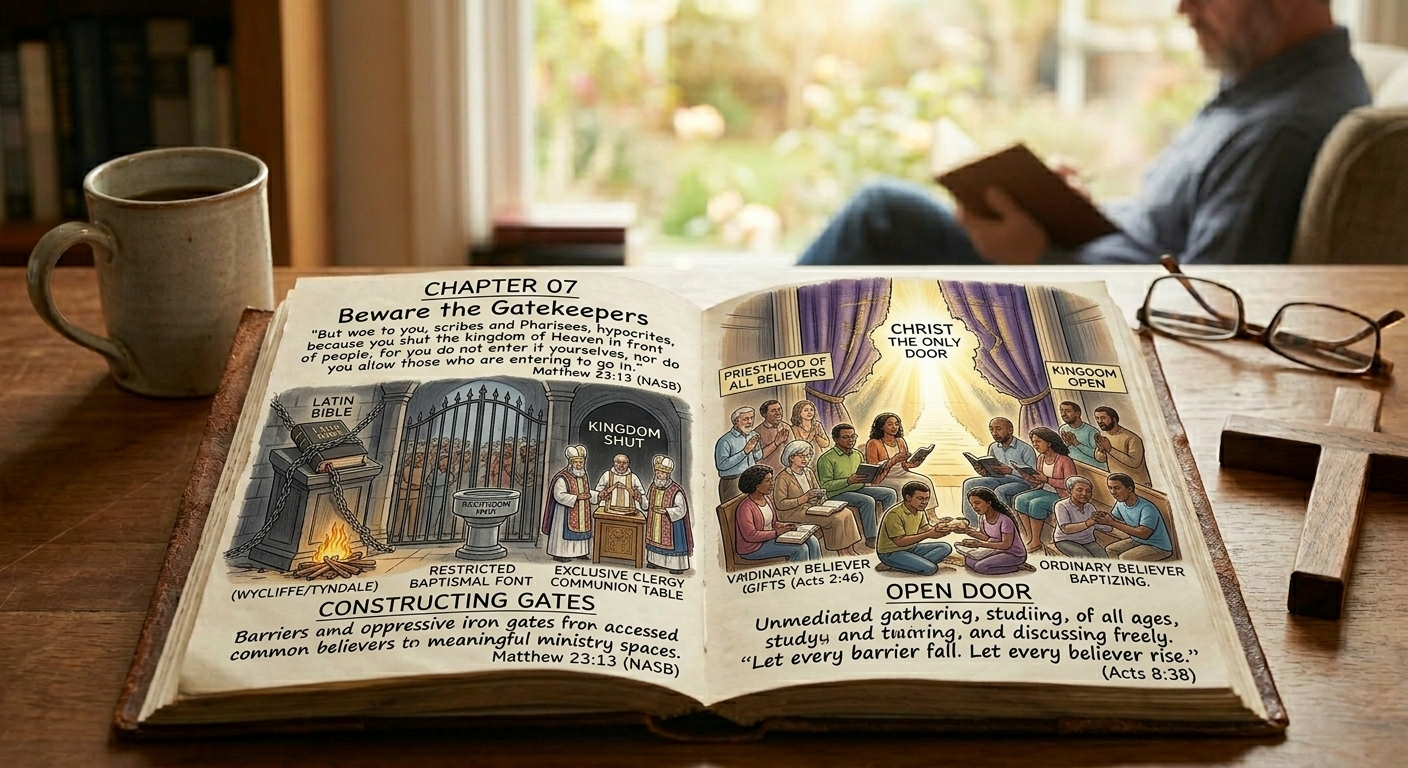
Chapter 07 – Beware the Gatekeepers
But woe to you, scribes and Pharisees, hypocrites, because you shut the kingdom of Heaven in front of people; for you do not enter it yourselves, nor do you allow those who are entering to go in.
Matthew 23:13 (NASB)
Constructing Gates
Satan has convinced church leaders throughout history that God’s people need human gatekeepers, that ordinary believers are too ignorant, too untrained, or too dangerous to read Scripture, minister to others, or approach God directly. This deception transforms the church from a priesthood of all believers into a spiritual hierarchy where only the approved few can truly serve God.
This lie manifests in three primary ways. First, there is the restriction of access to God’s Scriptures, where only certain people are deemed safe to read or interpret Scripture. Second, we see the restriction of access to ministry, with insistence that only credentialed or ordained individuals can serve in meaningful ways. Third, there is the restriction of access to God’s grace, teaching that sacraments and spiritual blessings flow only through institutional channels.
Each form of gatekeeping directly contradicts Christ’s work on the cross, which tore the temple veil and opened direct access to God for all believers. Yet in every generation, new gatekeepers arise, convinced they’re protecting the church when they’re actually perpetuating Satan’s ancient strategy of creating barriers between God and His people.
Gatekeeping God’s Word
The Historical Pattern
For over a thousand years, one of Satan’s most effective deceptions was convincing religious leaders that ordinary people couldn’t be trusted with Scripture. The Bible was kept in Latin, a language most couldn’t understand. Copies were literally chained to pulpits. The message was clear: you need us to tell you what God says.
Then came Johannes Gutenberg’s printing press in the 1450s; a technological revolution that became a spiritual earthquake. Suddenly, Bibles could be mass-produced. Scripture could reach farmers, merchants, and housewives, not just priests and nobles. The response from religious authorities was swift and violent.
The Price of Translation
Consider what happened to those who dared give people Scripture in their own language:
John Wycliffe (1320-1384) translated the Bible into English so common people could read the Scriptures. The Catholic Church was so enraged that Pope Martin V ordered Wycliffe’s bones exhumed and burned 44 years after his death. His followers, the Lollards, were hunted down. Some were burned alive with Wycliffe’s Bibles hung around their necks as kindling.
William Tyndale (1494-1536) declared his mission: “If God spare my life, ere many years I will cause a boy who drives the plough to know more of the Scriptures than you do.” For the crime of translation, he was strangled and burned at the stake. His dying prayer: “Lord, open the King of England’s eyes.”
The Constitutions of Oxford (1408) made it illegal to translate or read the Bible in English without official permission. The punishment was death.
The Index Librorum Prohibitorum (1559-1966) banned thousands of books, including Bibles in common languages. Possessing a vernacular Bible could mean excommunication, imprisonment, or death.
The Council of Trent’s Response
As Bibles spread and the Reformation gained momentum, the Catholic Church’s Council of Trent (1545-1563) formalized the gatekeeping. They declared that only the Magisterium, the teaching authority of the Church, could authentically interpret Scripture. The Latin Vulgate was proclaimed as the only authentic Bible, while laypeople were discouraged or forbidden from reading Scripture privately. Mass remained in Latin, incomprehensible to most attendees.
The justification? Protecting the ignorant from misinterpretation. The reality? Maintaining power by keeping people dependent on religious authorities for access to the Scriptures.
The Scriptural Refutation
Yet Scripture itself condemns this gatekeeping:
These words, which I am commanding you today, shall be on your heart. And you shall repeat them diligently to your sons and speak of them when you sit in your house, when you walk on the road, when you lie down, and when you get up.
Deuteronomy 6:6-7 (NASB)
God commanded the Scriptures be taught to children, discussed at home, and integrated into daily life; not reserved for religious professionals.
Jesus Himself rebuked those who hindered access to truth:
Woe to you lawyers! For you have taken away the key of knowledge; you yourselves did not enter, and you hindered those who were entering.
Luke 11:52 (NASB)
Modern Scriptural Gatekeeping
While most churches today encourage Bible reading, subtle forms of this gatekeeping persist. We’re told that you need seminary training to really understand Scripture, or that a passage doesn’t mean what it seems to mean without expert explanation. Some insist that only certain translations are reliable, while others require approval before anyone can teach Bible studies. They say that personal revelation must be verified by leadership.
This becomes particularly complex because Scripture itself acknowledges that some passages are difficult to understand. Peter wrote about Paul’s letters: “in which there are some things that are hard to understand, which the untaught and unstable distort, as they do also the rest of the Scriptures, to their own destruction” (2 Peter 3:16). The Ethiopian eunuch needed Philip to explain Isaiah (Acts 8:30-31). We are designed for community and must remember that iron sharpens iron (Proverbs 27:17).
The key is distinguishing between healthy interdependence and unhealthy dependence. Seeking wisdom from mature believers, comparing interpretations with trusted brothers and sisters, and submitting our understanding to the broader body of Christ, these are biblical practices. But when we’re told we cannot understand any Scripture without professional mediators, when personal study is discouraged in favor of only receiving approved interpretations, when questions are shut down rather than explored together; this crosses into gatekeeping.
Furthermore, we must allow room for differences in theological understanding on secondary matters. Throughout church history, sincere believers have disagreed on baptism methods, end times interpretations, spiritual gifts, and countless other issues while remaining united in Christ. The essentials: salvation by grace through faith, the deity of Christ, His death and resurrection, the authority of Scripture; these unite us. But demanding uniformity on every theological point creates barriers God never intended.
The enemy’s strategy remains consistent: convince believers they can’t hear from God directly through the Scriptures, creating unhealthy dependency on human intermediaries. But God’s design is for believers to study personally while also learning in community, to develop individual understanding while remaining teachable, to hold convictions while showing grace to those who differ on non-essential matters.
Gatekeeping Ministry
The Priesthood Dissolved and Rebuilt
When Jesus died, the temple veil tore from top to bottom (Matthew 27:51), symbolically destroying the barrier between God and humanity. The exclusive priesthood was abolished. Peter declared the revolutionary truth:
But you are a chosen people, a royal priesthood, a holy nation, a people for God’s own possession, so that you may proclaim the excellencies of Him who has called you out of darkness into His marvelous light.
1 Peter 2:9 (NASB)
Every believer, not just a select few, is called to priestly service. Paul reinforces this:
But to each one is given the manifestation of the Spirit for the common good.
1 Corinthians 12:7 (NASB)
The early church operated on this principle. When they gathered:
What is the outcome then, brothers and sisters? When you assemble, each one has a psalm, has a teaching, has a revelation, has a tongue, has an interpretation. All things are to be done for edification.
1 Corinthians 14:26 (NASB)
Ministry was participatory, not performative. Every member contributed according to their gifts.
The Return of the Religious Elite
Yet within centuries, the church recreated what Christ destroyed. A distinct clergy class emerged, separated from “laypeople” by ordination, vestments, and exclusive rights to minister. The priesthood of all believers became theory rather than practice.
This reached its peak in medieval Catholicism, where only priests could preach, pray certain prayers, enter certain spaces, handle sacred objects, or pronounce forgiveness. The Reformation challenged this, with Martin Luther proclaiming the priesthood of all believers. Yet ironically, many Protestant churches have recreated similar, yet smaller, hierarchies.
Modern Ministry
Today’s ministry gatekeeping takes sophisticated forms:
Credentialism: “You need a degree to serve”
Today’s ministry gatekeeping often centers on requiring seminary education for any teaching role, dismissing those without formal theological training, and creating multi-tier membership based on education. The subtle message suggests that God primarily calls the educated.
Yet Jesus chose fishermen, tax collectors, and zealots; not just scribes and Pharisees. Paul reminded the Corinthians:
For consider your calling, brothers and sisters, that there were not many wise according to the flesh, not many mighty, not many noble; but God has chosen the foolish things of the world to shame the wise.
1 Corinthians 1:26-27 (NASB)
Platform Protectionism: “Only approved people can minister publicly”
Churches often reserve preaching for ordained clergy, limit prayer to designated team members, restrict worship leading to auditioned musicians, and require committee approval for any ministry initiative. This contradicts Jesus’s design:
And He gave some as apostles, some as prophets, some as evangelists, some as pastors and teachers, for the equipping of the saints for the work of ministry, for the building up of the body of Christ.
Ephesians 4:11-12 (NASB)
Gift Suppression: “Your ministry doesn’t fit our model”
The church often operates like a body refusing to use certain parts, claiming most gifts listed in 1 Corinthians 12 are no longer valid or needed. Paul explicitly lists the gifts the Spirit distributes: the word of wisdom, the word of knowledge, faith, gifts of healing, the effecting of miracles, prophecy, discernment, various kinds of tongues, and the interpretation of tongues (1 Corinthians 12:8-10). He adds that God has appointed in the church apostles, prophets, teachers, miracles, gifts of healings, helps, administrations, and various kinds of tongues (1 Corinthians 12:28). Yet many churches today readily embrace teaching, helps, discernment, and administration while systematically suppressing prophecy, healing, miracles, tongues, and interpretation of tongues. Some even reject the ongoing ministry of these gifts despite Scripture providing no expiration date for them.
Paul explicitly states: “Now there are varieties of gifts, but the same Spirit. And there are varieties of ministries, and the same Lord” (1 Corinthians 12:4-5, NASB). When we suppress gifts because they make us uncomfortable or don’t fit our tradition, we’re telling the Holy Spirit which parts of His distribution we’ll accept, instead of allowing Him to build up the body as He sees fit. The irony is striking: churches that claim to follow biblical authority often ignore what the Scriptures actually teach about spiritual gifts. Instead, they create their own categories (accepting gifts like teaching and administration while rejecting prophecy, healing, and tongues) despite Scripture making no such distinction.
Real-World Consequences
When ministry is gatekept, believers remain spiritually immature, never exercising their gifts. The body of Christ operates at a fraction of its potential. Pastors burn out trying to do everything themselves while the lost aren’t reached because the laborers are benched. The church becomes an audience rather than an army.
Gatekeeping Grace
The Sacramental Monopoly
Perhaps nowhere is gatekeeping more audacious than in restricting access to God’s grace through control of the sacraments. What Christ offered freely, religious systems regulate and ration.
Baptism
Jesus commanded:
Go, therefore, and make disciples of all the nations, baptizing them in the name of the Father and the Son and the Holy Spirit.
Matthew 28:19 (NASB)
This was given to all disciples, not a special class. In Acts, we see ordinary believers baptizing. Philip, a deacon, baptized the Ethiopian eunuch (Acts 8:38). Ananias baptized Paul (Acts 9:10-18). Paul baptized household believers immediately upon conversion (Acts 16:33).
Yet many churches today insist that only ordained ministers can baptize, that baptisms must occur in church buildings, that candidates must complete extensive classes, and that committees must approve each candidate. When someone accepts Christ through your witness but must wait weeks for an “authorized” baptism, who is being served; Christ or institutional control?
Communion
Jesus said simply:
Do this in remembrance of Me.
Luke 22:19 (NASB)
The early church “broke bread from house to house” (Acts 2:46). Ordinary believers shared the Lord’s Supper in homes, celebrating Christ’s sacrifice together.
Yet throughout history and today, many churches forbid home communion, insist only clergy can “consecrate” elements, bar believers from the table for various reasons, and some require confession to a priest before participating. This gatekeeping suggests Christ’s sacrifice needs human mediation, that His grace flows only through approved channels. It contradicts Paul’s teaching that each person should examine themselves (1 Corinthians 11:28).
Grace
Beyond sacraments, grace is gatekept through various means.
Confession Control insists that you must confess to a priest for forgiveness, that only pastors can pronounce absolution, or that your sin requires leadership involvement. Yet Scripture says:
Therefore, confess your sins to one another, and pray for one another so that you may be healed.
James 5:16 (NASB)
Confession is to “one another,” not exclusively to clergy.
Blessing Barriers appear when only ordained ministers can pray for healing, baby dedications require pastoral approval, marriage ceremonies need denominational authorization, or house churches aren’t considered “real churches.” This denies that all believers are priests with direct access to God’s throne of grace (Hebrews 4:16).
The Heart of the Deception
What Gatekeepers Fear
Why do sincere religious leaders become gatekeepers? The same fears that motivated the Pharisees drive them today.
They fear loss of control, wondering how to maintain order if everyone can minister. They worry about doctrinal corruption, asking what happens to truth if anyone can teach. Their significance feels threatened when they question what makes clergy special if all are priests. Financial concerns arise as they wonder who will support the institution if home churches thrive. And tradition’s weight presses down as they ask whether changing now means they were wrong before.
These fears seem reasonable but reveal lack of faith in the Holy Spirit’s ability to lead, guide, and protect His church.
The Biblical Balance
Scripture does recognize leadership roles and qualifications (1 Timothy 3, Titus 1). It warns that not many should become teachers (James 3:1). It calls for order in worship (1 Corinthians 14:33).
But biblical leadership is about equipping, not restricting; empowering, not controlling; raising up, not holding down. True spiritual leaders rejoice when others minister effectively, like Moses when he said:
Are you jealous for my sake? If only all the Lord’s people were prophets, and that the Lord would put His Spirit upon them!
Numbers 11:29 (NASB)
Breaking Down the Gates
Recognizing Gatekeeping
How do you identify gatekeeping in your church? Look for concentration of ministry in a few hands, where the same small group of people perform all meaningful services. Notice lengthy processes to “qualify” for even basic service, with multiple hoops to jump through before you can serve in various Christian ministries. Listen for fear-based reasoning that emphasizes what might go wrong rather than trusting God’s Spirit. Watch for emphasis on credentials over character and calling, where degrees matter more than spiritual fruit.
Be alert to discouragement of home gatherings or “unauthorized” ministry, as if God’s work requires institutional permission. Notice who controls baptisms, communion, and public prayer. Pay attention when those without formal training are dismissed regardless of their obvious gifting. And observe whether ministry roles are territorially protected, with leaders threatened by others exercising similar gifts.
The Freedom Christ Offers
Jesus declared:
I am the door; if anyone enters through Me, he will be saved, and will go in and out and find pasture.
John 10:9 (NASB)
Jesus is the only door, no other gatekeeper needed. Through Him, every believer has direct access to the Father. Every Christian can minister according to their gifts. Every disciple can make disciples. Every saint has a vital function.
Practical Steps to Freedom
For Individuals:
- Study Scripture for yourself, trusting the Holy Spirit to guide.
- Exercise your spiritual gifts regardless of formal recognition.
- Share the gospel, disciple others, and serve without waiting for permission.
- Gather with believers in homes for prayer, communion, and ministry.
- Respectfully challenge unbiblical restrictions.
For Leaders:
- Examine whether your structures empower or restrict
- Focus on equipping rather than performing
- Celebrate when members minister without your involvement
- Remove unnecessary barriers to service
- Trust the Holy Spirit to guard His church
For Churches:
- Audit your practices: What requires “clergy only”? Why?
- Create clear, biblical pathways for everyone to minister
- Emphasize character over credentials
- Decentralize ministry beyond the church building
- Return to the participatory worship of 1 Corinthians 14:26
The Unstoppable Kingdom
Throughout history, God has demonstrated that His kingdom cannot be contained by human gatekeepers. When Rome tried to restrict Scripture to an elite clerical class, God raised up reformers who translated the Scriptures into common languages and spread it among the people. But when those very reformers and their followers became rigid in their own traditions, God sent waves of revival that broke through established religious structures. As denominations grew cold and institutional, God birthed new movements that recaptured the fire of authentic faith. When large institutions failed to reach the lost or disciple believers effectively, house churches began flourishing in living rooms and coffee shops. And when entire nations closed their doors to the gospel, it exploded with even greater power in unexpected places around the globe.
This pattern reveals God’s sovereignty over His own work. As Paul declared triumphantly from his prison cell:
I suffer hardship even to imprisonment as a criminal; but the word of God is not imprisoned
2 Timothy 2:9 (NASB)
No human gatekeeper, no matter how well-intentioned, theologically educated, or institutionally powerful; can ultimately stop what God has determined to accomplish. His Spirit moves where He wills, raises up whom He chooses, and accomplishes His purposes through vessels that religious establishments often overlook or reject.
But while gatekeepers cannot stop God’s work, they can delay it, diminish its effectiveness, and inflict real damage on those who should be serving in the harvest. The cost of their control extends far beyond hurt feelings or wounded pride.
The Warning Remains
Jesus’s words to the Pharisees echo through the centuries to every generation of religious leaders:
But woe to you, scribes and Pharisees, hypocrites, because you shut the kingdom of Heaven in front of people; for you do not enter it yourselves, nor do you allow those who are entering to go in.
Matthew 23:13 (NASB)
The Open Door
Christ died to tear down every barrier between humanity and God. He rose to empower every believer as a priest and minister. He sent His Spirit to gift and enable all His people for service.
When we rebuild the gates He destroyed: whether through restricting Scripture, monopolizing ministry, or controlling grace; we join forces with the very deception Satan has used for millennia. We may think we’re protecting the church, maintaining order, or preserving truth. But in reality, we’re shutting the kingdom of Heaven in people’s faces.
The church Jesus is building has no gatekeepers except Himself. It is a church where:
- Every believer reads and shares the Gospel
- Every member ministers according to their gifts
- Every saint has direct access to God
- Every disciple makes disciples
- And so much more
This isn’t chaos, it is the organized organism Paul describes in 1 Corinthians 12, where every part functions as designed. It is not disorder, it is the divine order of the Spirit; far superior to human control.
The gates of Hell cannot prevail against Christ’s church (Matthew 16:18). But too often, the gates of Heaven are guarded by well-meaning but deceived religious leaders who restrict what Christ offers freely.
It is time to recognize the deception, reject the gatekeeping, and return to the radical priesthood of all believers. The harvest is plentiful, but the laborers are few; not because God hasn’t called them, but because gatekeepers have benched them.
Let every barrier fall. Let every believer rise. Let the church be the church; not an institution with a few ministers, but a movement of millions of priests proclaiming the excellencies of Him who called us out of darkness into His marvelous light.
Reflections
Scripture Access: Have you been trusting others to interpret the Scriptures for you, or are you studying it yourself and relying on the Holy Spirit for guidance? What beliefs do you hold simply because a leader taught them rather than because you have found them in Scripture?
Ministry Participation: What gifts has God given you that remain unused because you lack “official” approval? What ministry is God calling you to that you have postponed waiting for permission?
Grace and Sacraments: Do you believe you need clergy mediation to receive God’s grace? Have you avoided baptizing new believers or sharing communion because you thought you weren’t “authorized”?
Gatekeeping Participation: Have you inadvertently become a gatekeeper yourself, discouraging others from ministering because they lack credentials or don’t fit the traditional model?
Freedom in Christ: What would change in your spiritual life if you truly believed you are a priest with direct access to God and full authority to minister in Christ’s name?
A Prayer for Us
Heavenly Father,
Thank You for tearing the veil and opening direct access to Your throne through Jesus Christ. Forgive us for the times we have rebuilt barriers You destroyed, when we have restricted what You released, when we have gatekept what You gave freely.
Lord Jesus, You are the only door, the only mediator, the only way to the Father. Free us from any deception that suggests we need human permission to approach You, serve You, or share You with others.
I pray for those who’ve been told they’re not qualified, not educated enough, not ordained, not approved. Remind them that You choose the foolish to shame the wise, the weak to shame the strong. Show them that their calling comes from You, not from committees.
For those in leadership, I pray for courage to release control, to equip rather than restrict, to celebrate when Your people minister without their oversight. Help them find their significance not in being the only minister but in raising up many ministers.
Holy Spirit, You have poured out Your gifts on all flesh; young and old, male and female, educated and simple. Stir up those gifts. Empower Your people to prophecy, teach, heal, evangelize, and serve regardless of human approval.
Break every chain of religious control. Shatter every barrier to ministry. Open every gate that’s been wrongly shut. Let Your church be what You designed; a royal priesthood, a holy nation, a people for Your own possession, all proclaiming Your excellencies.
For those who’ve been waiting for permission to serve You, I declare: You are authorized by the blood of Jesus. You are ordained by the Holy Spirit. You are commissioned by the Great Commission. Go and make disciples. Baptize believers. Share communion. Pray for the sick. Preach the gospel. Exercise your gifts.
And Lord, protect Your church from the opposite error, from chaos masquerading as freedom. Give wisdom to maintain biblical order while releasing biblical ministry. Help us hold truth and freedom in perfect balance.
In the name of Jesus Christ, who is the door no one can shut, Amen.