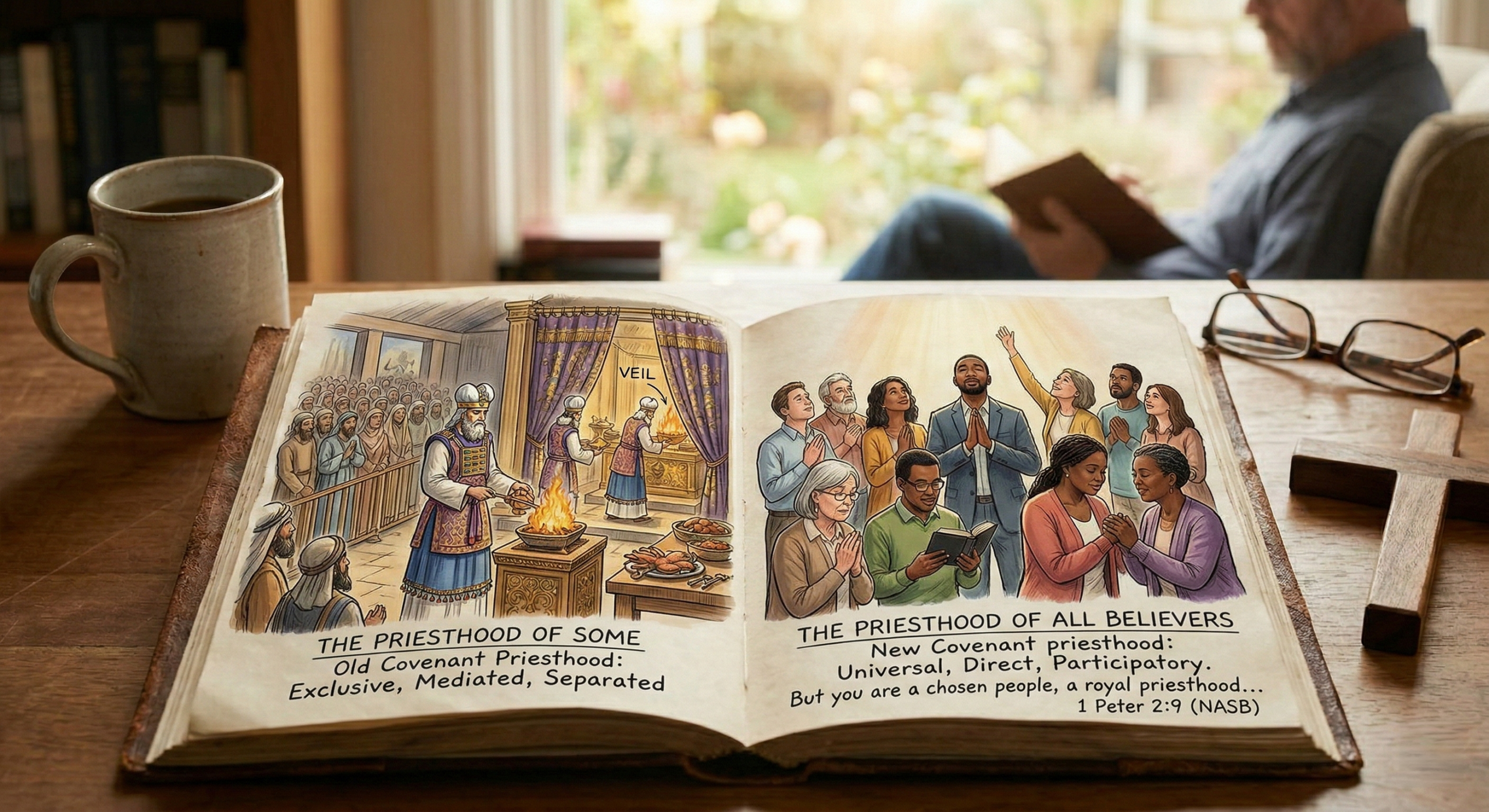
Chapter 06 – The Priesthood of Some
These are the names of the sons of Aaron, the anointed priests, whom he ordained to serve as priests.
Numbers 3:3 (NASB)
The Ministry God Intended
In the days of Moses, God established the office of the priest. Only those descended from Aaron, from the tribe of Levi, were set apart for this sacred work. Their tasks were specific, high-stakes, and absolutely central. The priests represented the people before God, offered sacrifices, maintained the tabernacle, taught the Law, and, once yearly, entered the Holy of Holies as mediator for the people (Exodus 28-29; Leviticus 16).
This system provided a powerful model: special clothing, sacred anointing, rigorous separation from the ordinary. The people depended on these priests for forgiveness, blessing, and spiritual leadership. The structure was exclusive by divine command, no one else dared take the role (Numbers 18:7).
For generations, the community of faith was shaped by this priesthood of a select few. Access to God required a mediator, and the worship of God was centered around what happened when the priest, set apart, holy, compensated by the offerings, stood between the holiest place and the multitude.
A Deception Perpetuated
Many churches today, consciously and unconsciously, pattern themselves on this old covenant structure. A small class of “professional Christians” (pastors, bishops, or elders) are considered set apart for “spiritual duties.” Most members have been conditioned, whether overtly or subtly, to see themselves as spectators or, at best, support staff. Their “job” is to show up, give, and receive ministry from the few.
This arrangement has become quite comfortable. It absolves the “everyday” believer from the responsibility and risk of spiritual leadership, shepherding, teaching, and more. It elevates a few as “ordained,” those literally paid to climb the mountain, stand in for the rest, and return with a Bible lesson on Sundays and sometimes Wednesdays.
But is this the model Jesus and the apostles intended for His Church? Or could it be that Satan, the Father of Deception, prefers a system where most believers remain passive and ministry is professionalized?
The Priesthood of All Believers
The coming of Jesus Christ marks a seismic shift in the story of God’s people, a drastic change in the way humanity approaches God. No longer bound by the strict limitations of the Old Covenant, the Church lives under a new and living way, opened by the very blood of our Savior. Jesus is not merely a High Priest among others, but the final and perfect High Priest (Hebrews 7:23-28), making all other mediators obsolete.
The old priesthood could only ever temporarily cover sin; the curtain in the Temple served as a constant, visible reminder of mankind’s separation from God’s presence. Only the High Priest could enter the Holy of Holies, and only once each year, bearing blood of an imperfect sacrifice (Hebrews 9:7). Yet at the moment Jesus died, the temple veil, thick, heavy, unbroken, was torn in two from top to bottom (Matthew 27:51), a shocking, divine declaration that the barrier was forever broken.
Through Christ’s once-and-for-all sacrifice, every believer is invited to approach God boldly and confidently:
Therefore, brothers and sisters, since we have confidence to enter the holy place by the blood of Jesus, by a new and living way which He inaugurated for us through the veil, that is, through His flesh, and since we have a great priest over the house of God, let’s approach God with a sincere heart in full assurance of faith, having our hearts sprinkled clean from an evil conscience and our bodies washed with pure water.
Hebrews 10:19-22 (NASB)
What had been the exclusive privilege of a single tribe was transformed into a universal calling for all who trust in Christ. Peter’s foundational declaration resonates as a summons to every child of God:
But you are a chosen people, a royal priesthood, a holy nation, a people for God’s own possession, so that you may proclaim the excellencies of Him who has called you out of darkness into His marvelous light.
1 Peter 2:9 (NASB)
No longer is spiritual service the province of a religious elite. In the age of the Holy Spirit, all believers are priests, able to pray directly to the Father, intercede for others, and offer spiritual sacrifices of praise, thanksgiving, repentance, generosity, and service (Romans 12:1; Hebrews 13:15-16).
The New Testament unfolds a vision of church life that is radically participatory, marked by the active involvement of every believer. Paul paints the picture in 1 Corinthians 12 of a living, breathing body. Each member is essential, each one uniquely gifted by the Spirit and indispensable to the whole. There is no room for spiritual spectators; the health of the body depends on the contribution of every part.
Likewise, in his letter to the Ephesians, Paul spells out the purpose of leaders in the church. Apostles, prophets, evangelists, pastors, and teachers are not meant to perform all the ministry themselves. Instead, their calling is to equip the saints, all of God’s people, for the work of ministry, so that the entire body is built up to maturity, strength, and unity. Ministry is not the special domain of a professional class, but the shared labor of the whole church.
And He gave some as apostles, some as prophets, some as evangelists, some as pastors and teachers, for the equipping of the saints for the work of ministry, for the building up of the body of Christ; until we all attain to the unity of the faith, and of the knowledge of the Son of God, to a mature man, to the measure of the stature which belongs to the fullness of Christ.
Ephesians 4:11-13 (NASB)
This participatory character of Christian fellowship comes to vivid life in 1 Corinthians 14:26, where Paul describes the gatherings of believers. “When you come together,” he writes, “each one has a hymn, a teaching, a revelation, a tongue, or an interpretation.” Each person arrives ready to offer something for the benefit of others. The early church meeting was far from the audience-oriented, clergy-centered events so familiar today. It was not a gathering of passive listeners but a Spirit-directed community where every voice could be heard and every gift could be used for God’s glory.
This shared priesthood means that ministry is participatory and humble, not hierarchical and passive. Discipleship is the work of all who follow Him, not only of a professional class. Caring for the broken, teaching truth, praying for the sick, and sharing the gospel are the birthright and responsibility of the entire church (James 5:14-16; Colossians 3:16; Hebrews 10:24-25).
Paid Pastor/Elder: A Modern Deception
But how did we slip back to the old system? Why the priesthood of some, and not all? Here, church tradition and practical convenience united to revert to a professionalized model. The lines blurred again: the crowd listens, while a few “do” ministry.
Drawing from my seminary experience and deep study of the Scriptures, I have realized that the practice of compensating a pastor or elder with a salary, while itself should not be considered “sinful,” has no real grounding in the New Testament. Quite the contrary, it has often stunted the spiritual maturity and responsibility of the Church.
Perhaps the most common text in the New Testament used to defend paying a pastor or elder is found in 1 Timothy 5:17-18:
The elders who lead well are to be considered worthy of double honor, especially those who work hard at preaching and teaching. For the Scripture says, ‘You shall not muzzle the ox while it is threshing,’ and ‘The laborer is worthy of his wages.’
1 Timothy 5:17-18 (NASB)
At first glance, this might seem to support paying a church leader. But a closer look shows otherwise. Paul uses the word honor (τιμή), which in Greek has the connotation of “respect.” Just verses before, he says, “Honor widows who are widows indeed” (1 Timothy 5:3), yet no one argues that widows should receive a salary from the Church. If “double honor” is a wage earned by the pastor, should widows, who we are commanded to honor (τιμή), receive half of the pastor’s salary?
Paul’s imagery is layered: yes, elders deserve honor, like oxen their grain, like laborers their wage, but elders are neither oxen nor common laborers. The context is showing that godly leadership deserves respect and provision, yet this never equates eldership to paid employment with job descriptions or credentials. Furthermore, later in this letter to Timothy, Paul says:
All who are under the yoke as slaves are to regard their own masters as worthy of all honor so that the name of God and our doctrine will not be spoken against.
1 Timothy 6:1 (NASB)
Again, we have to ask, if “honor” (τιμή) is a wage, should slaves pay their masters? The logical thread breaks down. It makes little sense that Paul would use the word “honor” (τιμή) five times in 1 Timothy, but in just one instance, he means “salary.”
The next most common verse used in defense of a paid pastor is found in 1 Corinthians 9:14: “So also the Lord directed those who proclaim the gospel to get their living from the gospel.” However, in context, Paul is speaking of traveling missionaries, like himself; those who left home and livelihood to take the gospel where it had not yet gone. But as Paul notes to the Corinthian Church, “I have used none of these things… for it would be better for me to die than have any man make my boast an empty one.” Paul prefers to offer the gospel “without charge.” And so, Paul made a living as a traveling tent maker, while also spreading the Gospel of Jesus Christ.
In Galatians 6:6, we read, “The one who is taught the word is to share all good things with the one who teaches him.” But again it becomes clear that this does not denote salary; it means sharing spiritual and material encouragement. The next verse suggest the reaping is spiritual, not financial.
For the one who sows to his own flesh will reap destruction from the flesh, but the one who sows to the Spirit will reap eternal life from the Spirit.
Galatians 6:8 (NASB)
In Philippians 4:14-19, Paul again thanks the church for gifts given while he was suffering and traveling. He was a missionary, not a local elder/pastor. The Philippians’ support was a timely gift in hardship, not a hired position or ongoing wage.
The Old Testament Model
Some argue that, like the Levites, today’s pastors should live off the offerings of the people, that the pattern of a paid, set-apart clergy comes straight from the priesthood established by God in Exodus, Leviticus, and Numbers. But let us take an honest look at what the Old Testament priesthood actually required. The standards, regulations, and restrictions placed on priests in the Law were exhaustive and often severe.
The requirements for Old Testament priests were staggering in their specificity and severity. Only men descended from Aaron could serve as priests; all others, including most Levites, were excluded (Exodus 28:1; Numbers 3:10). These priests had to maintain perpetual ritual purity, unable to approach the altar or eat sacred offerings if they had touched a corpse, had certain diseases, or failed in purification rituals (Leviticus 21-22).
Physical perfection was mandatory. No priest could serve if he had any defect; no blindness, lameness, disfigured faces, crippled limbs, skin diseases, or crushed testicles (Leviticus 21:16-23). Such restrictions would never be acceptable as standards for Christian ministry today. Their marriages were strictly regulated, permitting only virgin brides from Israel (Leviticus 21:7, 13-15). They wore prescribed holy garments when ministering, with high priests having even stricter requirements (Exodus 28:2-43).
The limitations on their lives extended to mourning and contact with the dead. Priests could not participate in normal mourning customs, and high priests could not even touch or be near the dead, even for close family (Leviticus 21:1-4, 10-12). They were responsible for complex, daily sacrificial rituals, and any deviation could be fatal, as seen in the deaths of Nadab and Abihu for strange fire (Leviticus 10:1-2). Unlike other tribes, priests received no land inheritance; their inheritance was the Lord and the offerings made by the people (Numbers 18:20-24).
If modern vocational pastors truly followed this model, they should face these same stringent restrictions on their personal lives, physical traits, family choices, and daily activities. However, no church today expects such a system, and with good reason. Deep down, we know that in Christ, something fundamentally changed.
The entire ceremonial, exclusive, and sacrificial system of the Old Covenant was never meant to be permanent. It was, “a copy and shadow of what is in Heaven” (Hebrews 8:5), always pointing ahead to Jesus, our Great High Priest. Christ perfectly fulfilled every prerequisite, bore every restriction, and offered the once-for-all sacrifice. In Him, “a new and living way” was opened for all.
The Priesthood We Have Neglected
When the Church organizes itself around a professional class; paid pastors, credentialed leaders, or those bearing special titles and institutional authority, a subtle but deeply damaging shift occurs. Ministry becomes the domain of just a few: those who are trained, appointed, and salaried for the task. Meanwhile, everyone else is quietly reduced to being spectators, donors, or occasional volunteers.
But this is not just a structural problem; it is a spiritual tragedy. In relying on a professional class, we surrender not only the practical work of ministry but also the very blessings Christ intends for every believer. Each act of service, each risk of faith, and each moment of genuine prayer or teaching is a divine opportunity to encounter God’s power, grow in intimacy with Christ, and deepen our dependence on Him. When we consistently leave these sacred moments at the feet of others, we rob ourselves, and each other, of the life-transforming work God wants to do through us.
Paul’s hope, again and again in his letters, was for a church where “everyone would be presented mature in Christ” (Colossians 1:28). This kind of maturity does not spring from passivity but is cultivated as believers share burdens, teach one another, offer hospitality, care for the sick, make disciples, pray fervently, and steward the gifts given by the Spirit. Every believer is required; every member is vital.
Yet when we outsource core responsibilities for prayer, discipleship, evangelism, or acts of mercy to “the professionals,” we actually contradict the teaching of Ephesians 4:11-12, which tells us that church leaders exist “to equip the saints for the work of ministry, for building up the body of Christ.” When the saints are not equipped and released, the body is weakened. Professional ministers may exhaust themselves, and the church at large remains spiritually immature, dependent, insecure, and easily deceived.
What often begins as a pursuit of efficiency or convenience rapidly becomes spiritual complacency. We slip into being mere consumers of religious goods and services, not contributors to God’s mission. The result is a church that may gain in orderliness or reputation, but loses what matters most: the passion, courage, maturity, and deep relationship with God that comes only when each member embraces their calling as a priest.
Paul paints a vivid picture of the church as a living body (1 Corinthians 12:14-26) made up of many different parts. Each part has a unique role to play, and none can claim to be less important because of its function. The foot cannot say it does not belong to the body because it is not a hand, nor can the ear disconnect itself because it is not an eye. Every member has been placed in the body exactly as God desired, and the diversity is crucial. If the whole body were just one part, it would not be a body at all.
Paul continues: just as no body part can claim independence from the others, so no believer can say to another, “I do not need you.” Even the parts that seem weaker or less honorable are, in truth, absolutely necessary and worthy of special care and recognition. God designed the body this way so that there would be no division, but instead a deep, mutual concern. When one part suffers, everyone suffers with it; when one part is honored, everyone rejoices together.
Reflections
Leadership Assessment: How has your understanding of spiritual leadership shaped who you consider responsible for the work of ministry? Where have you seen the “priesthood of some” mentality limiting God’s work in your church?
Personal Responsibility: Are there ways you have neglected your priestly calling, preferring to let paid staff handle your part of caring, teaching, or serving in the body of Christ?
Vision Casting: What might change in your church if everyone truly embraced being “a royal priesthood” (1 Peter 2:9)? How would relationships, service, and outreach be transformed?
Honor Assessment: Is there a leader or elder you need to honor; not with expectations of perfection, but with genuine respect, encouragement, or practical support?
Action Step: Where can you step out today in faith to serve, encourage, teach, or help others as a priest of Christ in your community?
A Prayer for Us
Heavenly Father,
You are the God who tears veils and breaks barriers, who opened the way for all Your children to approach Your throne with boldness. Thank You for the blood of Jesus that has made us all priests, able to serve You directly and minister to one another.
Lord Jesus, You are our Great High Priest who entered once and for all into the Holy Place. Forgive us for recreating the very barriers You died to destroy, for settling into spectator Christianity when You have called us to active participation in Your kingdom work.
We confess that we have often preferred the ease of letting others do ministry while we remain passive consumers. We have hidden behind our fears and excuses, allowing a few to carry burdens You designed for the entire body to share.
Holy Spirit, awaken Your church to the truth of our royal priesthood. Break down the artificial walls between “clergy” and “laity” that have no foundation in Your desires. Stir up the gifts You have placed within every believer and give us courage to step into service.
Transform the Church from audiences into armies, from consumers into contributors. Let every gathering be marked by the active participation of every member, each one bringing their gifts for the building up of the whole body.
In the name of Jesus Christ, our Great High Priest who has made us all priests unto God, Amen.