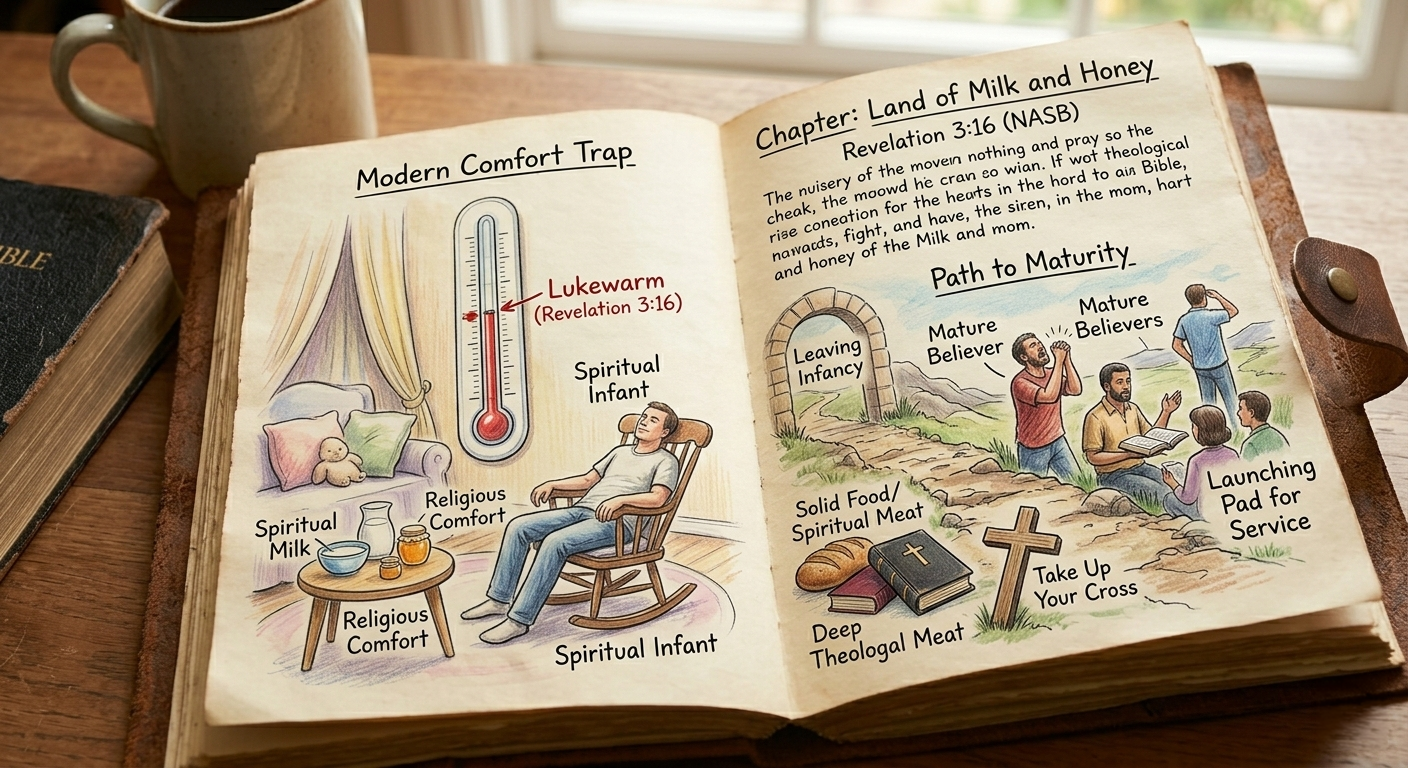
Chapter 08 – Land of Milk and Honey
So because you are lukewarm, and neither hot nor cold, I will vomit you out of My mouth.
Revelation 3:16 (NASB)
Addicted to Milk
In many ways, Satan has convinced the modern church that spiritual comfort is the goal of Christian life. That God’s highest desire is for His children to remain in a state of perpetual ease, feeding on spiritual milk and honey while carefully moderating any passion that might be labeled “extreme.” This deception transforms what should be a launching pad into a permanent dwelling place, keeping believers in spiritual infancy while convincing them they’ve achieved mature balance.
The enemy whispers two complementary lies. First, that difficulty is to be avoided, that challenging doctrines should be ignored, and that the sweet comfort of basic truths is all God requires. Second, that passionate devotion to Christ is dangerous and unwise, that true spiritual maturity means measured, moderate, carefully controlled faith that never makes others uncomfortable. Together, these lies create a church of spiritual infants who mistake their lukewarmness for wisdom and their complacency for contentment.
From Blessing to Bondage
When God promised Israel “a land flowing with milk and honey” (Exodus 3:8), He offered a vision of divine abundance. To slaves who had known only bitterness, this meant freedom, joy, and rest in God’s provision. Yet this blessing came with expectation. The comfort was meant to free God’s people for worship and service, not to lull them into spiritual sleep.
Moses warned:
When you have eaten and are satisfied, you shall bless the LORD your God for the good land which He has given you. Beware that you do not forget the LORD your God by not keeping His commandments.
Deuteronomy 8:10-11 (NASB)
But Israel’s history reveals what happens when comfort becomes the goal. Generation after generation treated God’s gifts as entitlements while ignoring His commands. As Hosea lamented:
When they had their pasture, they became satisfied, and being satisfied, their heart became proud; therefore they forgot Me.
Hosea 13:6 (NASB)
The pattern was predictable: comfort led to complacency, complacency to compromise, compromise to captivity.
The New Testament Shift
In the New Testament, the “milk and honey” metaphor is further realized. Milk is no longer the blessing at journey’s end but the food of spiritual beginners. Paul confronts the Corinthians with frustrated disappointment:
I gave you milk to drink, not solid food; for you were not yet able to consume it. But even now you are not yet able, for you are still fleshly.
1 Corinthians 3:2-3 (NASB)
The author of Hebrews expresses similar frustration:
For though by this time you ought to be teachers, you have need again for someone to teach you the elementary principles of the actual words of God, and you have come to need milk and not solid food.
Hebrews 5:12 (NASB)
Notice the phrase “by this time.” There’s an expectation of growth, a timeline for maturity. But instead of advancing to solid food, many had moderated themselves into perpetual infancy, finding a comfortable middle ground that required neither growth nor passion.
The Laodicean Mirror
Jesus’s words to the church in Laodicea in the book of Revelation reveal where this leads:
I know your deeds, that you are neither cold nor hot; I wish that you were cold or hot. So because you are lukewarm, and neither hot nor cold, I will vomit you out of My mouth.
Revelation 3:15-16 (NASB)
The Laodiceans weren’t pagans or heretics. They were Christians who had perfected the art of comfortable faith; still believing, still gathering, still maintaining the forms of religion, but without burning passion or consuming zeal. They had achieved perfect moderation, and it made Christ sick.
What is particularly revealing is their self-perception:
Because you say, ‘I am rich, and have become wealthy, and have need of nothing,’ and you do not know that you are wretched and miserable and poor and blind and naked.
Revelation 3:17 (NASB)
They thought their moderation was maturity, their lukewarmness was balance, their diet of milk and honey was sufficient nourishment. This is the heart of the deception: those most afflicted are often the last to recognize it.
The Modern Comfort Trap
Today’s church has perfected systems to keep believers in comfortable infancy. Services are crafted for comfort: familiar songs that soothe rather than challenge, messages that encourage without convicting, programs that entertain without transforming. We have turned worship into a weekly dose of spiritual comfort food, carefully calibrated to make people feel better without calling them to a higher ideal in Christ.
The sermons stay safely in the shallow end. God loves you, has a plan for your life, wants to bless you. These truths aren’t wrong, but when they’re all we hear, we remain infants. The controversial teachings of Jesus about taking up crosses, losing lives to find them, and the cost of discipleship are quietly ignored or quickly passed over. The challenging doctrines about God’s holiness, human sinfulness, and the necessity of repentance are too often softened or skipped.
Meanwhile, we have learned to view passionate faith with suspicion. Emotional expression in worship makes us uncomfortable. Extended prayer seems impractical in our busy lives. Bold evangelism feels socially awkward. Sacrificial giving appears financially unwise. Without meaning to, we have created a culture where measured faith is seen as mature faith, where those who go “all in” are gently cautioned about balance and wisdom.
We have developed phrases to reinforce this false moderation: “Let’s not be so Heavenly minded that we’re no earthly good.” “Everything in moderation, including religion.” “We don’t want to come across as fanatics.” These sayings sound wise, and sometimes are, but they often justify lukewarmness.
The Sweetness That Deceives
Satan doesn’t just keep us on milk, basic spiritual truths, he adds honey, the artificial sweetness of religious experience divorced from genuine transformation. This honey comes in many forms:
- The honey of emotional worship that makes us feel close to God without requiring obedience.
- The honey of inspirational messages that tell us we’re amazing without calling us to holiness.
- The honey of religious activities that make us feel spiritual without producing spiritual fruit.
- The honey of community that accepts us as we are without urging us toward who God calls us to be.
This sweetness becomes addictive. Churches compete to offer the most appealing honey: the best music, the most inspiring speakers, the most comfortable environments. Believers church-hop, seeking the sweetest experience, the most affirming message, the least challenging gospel. We have become spiritual consumers, sampling honey from various hives but never growing strong enough to produce any ourselves.
The Price of Lukewarmness
This comfortable Christianity costs more than we realize. When we moderate our passion for God and remain on spiritual milk, we don’t become balanced, we become powerless. The lukewarm church may be respectable, but it is also ineffective.
Consider what comfortable believers miss:
- The joy of wholehearted worship, where self-consciousness disappears in God’s presence.
- The satisfaction of sacrificial giving, where trust in God’s provision overcomes fear.
- The thrill of bold witness, where the Spirit speaks through trembling lips.
- The depth of prayer that transforms both the prayer and the world.
- The meat of deep theological understanding, where God’s character becomes clearer and more beautiful.
Ultimately, lukewarm faith fails to transform lives. The moderate Christian remains largely unchanged year after year, their character unformed, their habits unbroken, their witness ineffective. They may avoid the valleys of failure, but they also miss the mountaintops of victory.
The world looks at lukewarm Christianity and yawns. Why would anyone reorganize their entire life for something that its own adherents approach with such measured indifference?
True Maturity vs. False Moderation
Biblical self-control was never meant to dampen our passion for God, it was meant to control our passion for sin. True self-control doesn’t reduce holy fire; it prevents unholy fire. It doesn’t diminish our love for Christ; it directs our love away from the world.
Consider how Scripture describes proper spiritual temperament. Jesus said the greatest commandment is to love the Lord your God with all your heart, soul, mind, and strength (Mark 12:30). Not with some. Not with measured affection. Not with careful moderation. With ALL.
David danced before the Lord with all his might, so undignified that his wife despised him for it (2 Samuel 6:14-16). Mary poured out perfume worth a year’s wages on Jesus’s feet, an act the disciples called wasteful (John 12:3-5). Paul counted everything as rubbish compared to knowing Christ (Philippians 3:8).
These weren’t people lacking self-control. Their self-control enabled their devotion rather than restraining it. They could give everything to God because they had learned to give nothing to sin.
What Solid Food Looks Like
Moving from milk and honey to solid food doesn’t mean abandoning joy for joylessness. It means discovering deeper joys, richer sweetness; the satisfaction that comes only from spiritual maturity.
Solid food means:
- Wrestling with Scripture’s difficult passages rather than avoiding them.
- Embracing doctrines that challenge our preferences and prejudices.
- Practicing the difficult teachings of Jesus; actually loving enemies, genuinely forgiving, taking up our cross daily.
- Taking responsibility for others’ spiritual growth through teaching and discipling.
- Developing spiritual disciplines that go beyond the comfortable.
This mature diet produces believers who can digest solid truth and serve it to others, who can stand firm in trials, speak truth in love, and demonstrate that following Christ is about transformation, not just comfort.
Breaking Free from Comfort
The path from spiritual infancy to maturity requires honest assessment. How long have you been a believer? What growth should be evident by now? If you have been a Christian for years but still need the basics repeatedly explained, still struggle with elementary truths, still require constant encouragement to maintain faith, perhaps you have believed the lie that comfort is the goal.
Begin by examining what you have moderated out of your faith:
- Have you stopped praying fervently because it seemed excessive? Return to your knees.
- Have you restrained your worship to fit cultural comfort? Release your praise.
- Have you limited your giving to maintain lifestyle? Renew your generosity.
- Have you silenced your witness to avoid offense? Reclaim your voice.
Reject the consumer mentality that shops for the most comfortable church, the most affirming message, the least challenging discipleship. Instead, seek environments that stretch you, messages that convict you, relationships that sharpen you.
Embrace difficulty as God’s tool for growth. When Scripture challenges you, lean in rather than backing away. When service costs you, pay the price gladly. When obedience requires sacrifice, remember that the path to spiritual maturity always leads through discomfort.
The True Feast
God never intended His children to survive on milk and honey alone, nor to approach Him with lukewarm affection. Beyond the basics lies a feast of spiritual maturity that satisfies in ways comfort never could.
The heroes of faith in Hebrews 11 weren’t celebrated for their balance but for their abandon. They “conquered kingdoms, performed acts of righteousness, obtained promises, shut the mouths of lions” (Hebrews 11:33). Others were tortured, mocked, stoned, sawn in two; not one commended for their moderation.
The early church turned the world upside down not through careful balance but through Spirit-empowered boldness. They weren’t accused of being lukewarm but of being drunk with new wine. They weren’t known for their moderation but for their willingness to die for their faith.
Choose Your Temperature
Satan’s comfort deception has convinced millions that spiritual moderation is spiritual maturity, that measured faith is wise faith, that God prefers politeness to passion. But Christ’s message is clear: lukewarm believers, comfortable in their moderation and content with their milk, don’t even realize they’re in danger of being spat out.
The choice before us isn’t between reckless extremism and careful moderation. It is between wholehearted devotion and halfhearted religion, between spiritual infancy and maturity, between comfort and transformation.
In a world desperate for authentic Christianity, comfortable faith offers nothing. But believers who’ve moved beyond milk to meat, who burn hot rather than smolder lukewarm, whose self-control channels rather than quenches their passion, these are the Christians who change the world.
It is time to reject the comfortable Christian deception. Time to stop confusing apathy with balance, mediocrity with maturity, lukewarmness with wisdom. Time to grow up from milk to solid food, to let the Spirit reignite the fire that false moderation has nearly extinguished.
The land of milk and honey was never meant to be a nursery but a launching pad. The comfort was meant to enable service, not replace it. Be hot or be cold, feast on meat, and don’t remain a comfortable Christian.
Reflections
Spiritual Diet Assessment: How long have you been a Christian, and are you still feeding on the same elementary truths you learned at conversion? What “solid food” doctrines do you avoid because they challenge your comfort?
Temperature Check: If Jesus evaluated your faith today as hot, cold, or lukewarm, which would He choose? What specific areas of your life reveal a carefully moderated faith?
Growth Inventory: Can you identify three specific ways you have grown spiritually in the past year? If not, what does this reveal about your commitment to maturity?
Ministry Impact: Who are you currently discipling or teaching? If no one, how can you claim spiritual maturity while refusing the responsibility to feed others?
Comfort Zones: What spiritual practices have you abandoned or moderated because they seemed excessive? Prayer? Fasting? Witnessing? Giving? How has the desire for balance become an excuse for lukewarmness?
A Prayer for Us
Heavenly Father,
Forgive us for accepting spiritual infancy as maturity when You called us to mature in Christ. We have traded the meat of transformation for the milk of comfort, the fire of devotion for the lukewarmness of moderation.
Lord Jesus, You called us to love God with ALL our heart, soul, mind, and strength. You commanded us to be either hot or cold. Yet we have moderated ourselves into uselessness, choosing comfort over calling, ease over growth, milk over meat.
Break the comfortable Christian deception over our lives. Shatter the systems that keep us in perpetual infancy. Destroy the fear of being labeled extreme that prevents wholehearted devotion. Replace complacency with holy hunger, lukewarmness with fire, milk with meat.
Holy Spirit, move us from spiritual infancy to adulthood. Give us appetite for solid food, courage to embrace difficulty, passion that refuses to be moderated. Make us dangerous to complacency and useful for the Kingdom.
When comfort calls, remind us of the cross. When moderation beckons, show us the heroes of faith who were never moderate. When milk seems sufficient, create a hunger for meat that cannot be satisfied with less.
Protect us from both extremes, the chaos of unbridled emotionalism and the death of lukewarm moderation. Give us self-control that channels passion toward You rather than quenching it. Keep us growing even when growth is painful.
Raise up a generation that refuses comfortable Christianity. May we feast on solid food, burn with holy fire, embrace difficulty as God’s tool for growth, and demonstrate that following Christ means transformation, not just comfort.
In the name of Jesus, who was never lukewarm, never remained an infant, and never chose comfort over the Father’s will, Amen.