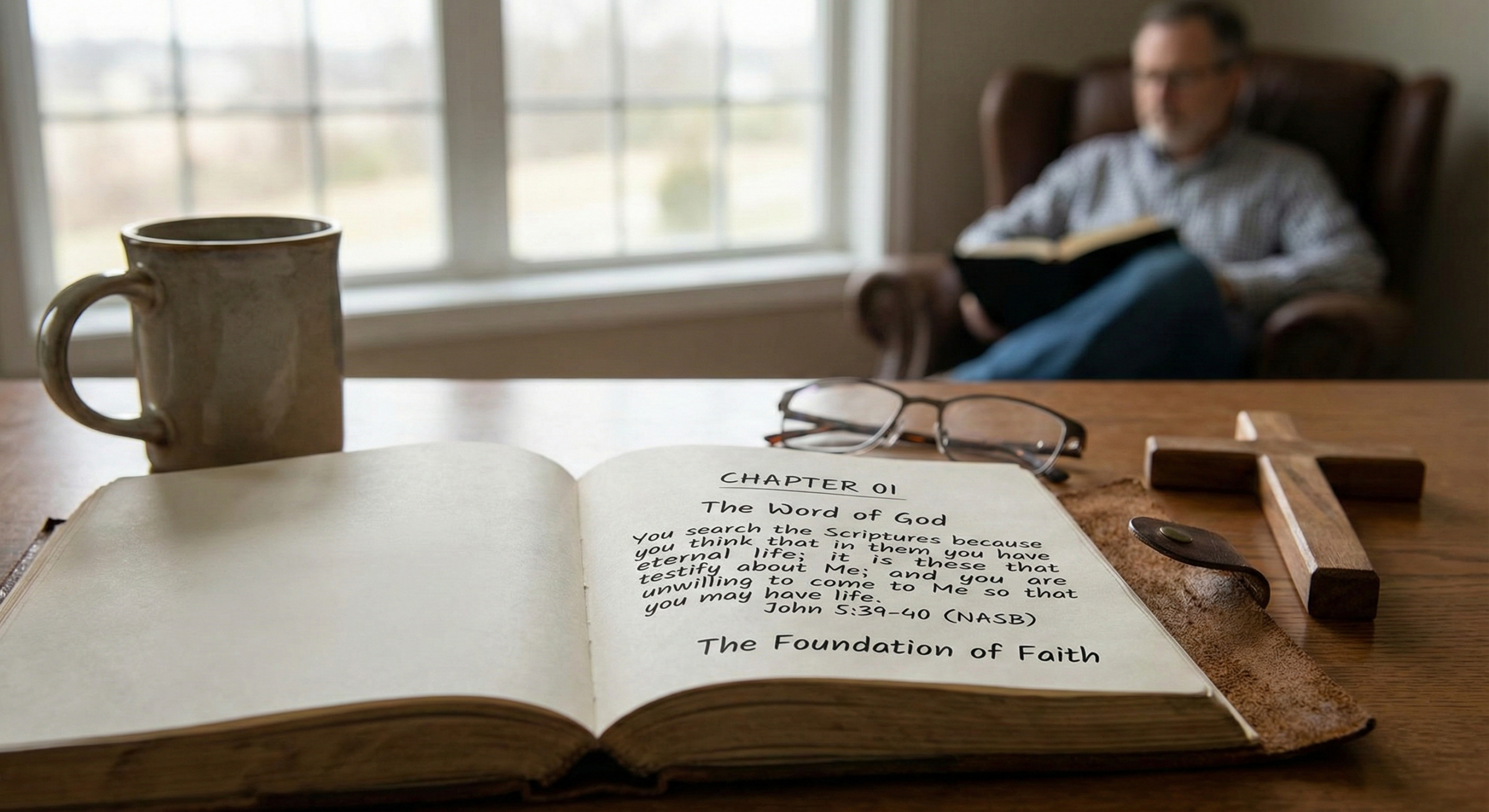
Chapter 01: The Word of God
You search the Scriptures because you think that in them you have eternal life; it is these that testify about Me; and you are unwilling to come to Me so that you may have life.
John 5:39-40 (NASB)
The Foundation of Faith
These words from Jesus challenge us to examine something fundamental about our faith: Are we seeking the right source of life? Are we, perhaps without realizing it, making the same mistake as the Pharisees; placing our trust in something that points to God rather than in God Himself?
In this chapter, I want to explore a truth that may initially seem unsettling but will ultimately strengthen your faith: The Bible, precious and authoritative as it is, is not itself the Word of God. Christ alone bears that title. Understanding this distinction isn’t mere semantics, it is the foundation of Christian discernment and the difference between genuine faith and subtle idolatry.
Who Is the Word of God?
The Apostle John leaves no room for ambiguity about the identity of the Word:
In the beginning was the Word, and the Word was with God, and the Word was God… And the Word became flesh, and dwelt among us, and we saw His glory, glory as of the only begotten from the Father, full of grace and truth.
John 1:1,14 (NASB)
The Word is not ink on papyrus but the Living Christ. Jesus Himself, the second person of the Trinity, is the Logos (λόγος), the Word; God’s ultimate and personal communication to humanity. The book of Revelation confirms this directly:
He is clothed with a robe dipped in blood, and His name is called The Word of God.
Revelation 19:13 (NASB)
This understanding transforms how we read the Old Testament. When we encounter the phrase “the word of the LORD came to…” we must remember that no Bible existed then. Abraham, Nathan, and Ezekiel didn’t possess a leather-bound book. Something, or rather, Someone, came to them:
After these things the word of the Lord came to Abram in a vision, saying, ‘Do not fear, Abram, I am a shield to you; Your reward shall be very great.’
Genesis 15:1 (NASB)
This Word that came was personal, active, and relational. Many early church fathers understood these appearances as the pre-incarnate Christ Himself, speaking on behalf of the Father. The writer of Hebrews confirms this understanding:
God, after He spoke long ago to the fathers in the prophets in many portions and in many ways, in these last days has spoken to us in His Son, whom He appointed heir of all things, through whom also He made the world.
Hebrews 1:1-2 (NASB)
The Beautiful Imperfection of Scripture
Now, let me address something that may trouble some readers but ultimately points us to a deeper trust in God. The Scriptures we hold today, while remarkably preserved and entirely trustworthy for faith and practice, are not perfect in the absolute sense that God alone is perfect.
Through the discipline of textual criticism; comparing ancient manuscripts including the Dead Sea Scrolls, the Masoretic Text, and the Septuagint; scholars generally agree that our Old Testament is approximately 95% certain in its reconstruction, while the New Testament reaches about 99% certainty. These percentages reflect minor variations in spelling, word order, and other details that do not affect any major doctrine.
Some may find this troubling. From pulpits across our land, we often hear statements like, “If there is but one error in this Bible, the whole thing can be thrown out.” But such statements, however well-intended, can actually harm faith rather than protect it.
Consider the new believer who is told the Bible is absolutely perfect in every detail, without any variation or uncertainty. When they inevitably encounter discussions of manuscript differences, as Satan will ensure they do, their faith built on the wrong foundation may crumble. They might reasonably wonder, “If my teacher was wrong about the Bible’s perfection, what else were they wrong about?”
And everyone who hears these words of Mine, and does not act on them, will be like a foolish man who built his house on the sand. And the rain fell and the floods came, and the winds blew and slammed against that house; and it fell; and its collapse was great.
Matthew 7:26-27 (NASB)
The Purposeful Imperfection
I believe this imperfection serves a divine purpose. If we possessed a physically perfect book, we might be tempted to worship it rather than the God it reveals. We might trust in our own ability to interpret rather than depending on the Holy Spirit whom Jesus promised:
But the Helper, the Holy Spirit, whom the Father will send in My name, He will teach you all things, and bring to your remembrance all that I said to you.
John 14:26 (NASB)
Jesus didn’t leave us with a perfect book; He left us with something better; His perfect Spirit to guide us into all truth. Although the Scriptures are not themselves divine. They are the inspired, authoritative witness to God’s work of salvation throughout history.
All Scripture is inspired by God and beneficial for teaching, for rebuke, for correction, for training in righteousness; so that the man or woman of God may be fully capable, equipped for every good work.
1 Timothy 2:16-17 (NASB)
Understanding Hebrews 4:12
One passage often misapplied to the Bible itself is Hebrews 4:12:
For the Word of God is living and powerful, and sharper than any two-edged sword, piercing even to the division of soul and spirit, and of joints and marrow, and is a discerner of the thoughts and intents of the heart.
Hebrews 4:12 (NASB)
Read in context with the very next verse, the meaning becomes clear:
And there is no creature hidden from His sight, but all things are naked and open to the eyes of Him to whom we must give account.
Hebrews 4:13 (NASB)
Notice the pronouns: “His sight,” “Him to whom.” The author isn’t describing a book but a Person. The Word of God who pierces our souls, discerns our thoughts, and sees all things is Christ Himself.
Why This Distinction Matters
This isn’t theological hair-splitting. When Christians inadvertently equate the Bible with Christ Himself, several dangers emerge:
Brittle Faith
If someone’s faith rests on the absolute perfection of a book rather than the absolute perfection of Christ, a single difficult passage or textual variant can become a stumbling block.
Biblical Idolatry
Yes, even good things can become idols. When we attribute to the Bible qualities that belong to God alone: perfection, holiness in the absolute sense, the power to save; we have crossed into dangerous territory.
Missing the Person for the Pointer
The Scriptures are meant to lead us to Christ. If we stop at the Scriptures themselves, we’re like someone who studies a map so intently they never actually take the journey.
Legalism Over Relationship:
When the Bible becomes the Word instead of Christ, faith can devolve into rule-keeping rather than relationship.
The Proper Place of Scripture
Please don’t misunderstand, I’m not diminishing Scripture’s authority or importance. The Scriptures are God-breathed and profitable as stated in 2 Timothy 3:16. It is completely trustworthy for faith and practice, serving as our authoritative guide for doctrine and life. Through its pages, God reveals His character and will in ways we could never discover on our own. His providence has protected these texts through history, preserving them for each generation.
But the Scriptures are not Christ Himself. They bear witness to Christ. They reveal Christ. They point us to Christ. But only Jesus Christ is the living Word of God.
A Living Relationship
This understanding should not weaken our faith; it should strengthen it. Instead of trusting in our interpretation of ancient texts, we trust in the living God who speaks through those texts by His Spirit. Instead of worshiping a book, we worship the God the book reveals. Instead of searching the Scriptures as an end in themselves, we search them to find Christ.
Consider how this transforms Bible study. We don’t approach the text as a magical book where perfect understanding comes from perfect study methods. We approach it as a meeting place where the living Christ speaks to us by His Spirit through His inspired witnesses. We come expecting not just information but transformation through encounter with the Word Himself.
Moving Forward in Freedom
Understanding that Christ alone is the Word of God frees us from several burdens. We don’t have to defend every manuscript variation or pretend the Bible fell from Heaven perfectly formatted. We don’t have to make the Bible something it never claims to be, and we can honestly acknowledge difficulties while maintaining faith.
Most importantly, it frees us to place our trust where it belongs; not in a book about God, however inspired, but in God Himself.
An Invitation to Deeper Faith
As we continue this journey together through the deceptions Satan brings to the church, remember that all truth comes from God, and all deception comes from the enemy. Sometimes the most dangerous deceptions are those wrapped in religious language and pious tradition.
The distinction between the Bible and the true Word of God isn’t meant to shake your faith but to establish it on the proper foundation; Christ Himself, the living Word, who was in the beginning, who became flesh, and who lives forever to intercede for us.
In the chapters ahead, we’ll explore other subtle deceptions that can creep into our faith. But for now, I invite you to sit with this truth: Your salvation doesn’t depend on your ability to understand or defend every verse. It depends on the living Word of God, Jesus Christ, who knows you, loves you, and speaks to you today through His Spirit and His Scriptures.
May this understanding draw you closer to Him, free you from false burdens, and establish your faith on the unshakable foundation of Christ Himself.
Reflections
Personal Examination: How have you traditionally understood the phrase “Word of God”? In what ways might you have unconsciously placed your faith in the Bible itself rather than in the Christ to whom it points?
Practical Application: Think about your current Bible study practices. How might approaching Scripture as a meeting place with the living Christ (rather than as an end in itself) change the way you read and study? What would it look like to depend more fully on the Holy Spirit’s guidance in your reading?
Faith Foundation: Have you ever experienced doubt or confusion when encountering difficult biblical passages or learning about manuscript variations? How does understanding Christ as the perfect Word of God, rather than requiring a “perfect” Bible, affect your confidence in your faith?
Relationship vs. Rules: Jesus criticized the Pharisees for searching the Scriptures but being unwilling to come to Him (John 5:39-40). In what areas of your spiritual life might you be focusing more on biblical knowledge or religious rules rather than pursuing a living relationship with Christ?
Moving Forward: If Christ Himself is the living Word of God who speaks to us today through His Spirit and the Scriptures, what is one specific way you can cultivate a more receptive heart to hear His voice this week? What might need to change in your spiritual practices to prioritize encountering Him rather than just learning about Him?
A Prayer for Us
Dear Heavenly Father,
I lift up my dear brother or sister who has just wrestled with these truths. Lord, I know that challenging long-held understandings can be unsettling, even when it draws us closer to You. I pray that Your Holy Spirit would bring comfort where there is discomfort, clarity where there is confusion, and deeper faith where there might be doubt.
Guard our heart against the enemy’s attempts to use this teaching to diminish our trust in Your Scriptures. Instead, may this understanding increase our hunger for Your Word; both the written word that testifies of Christ and the Living Word who is Christ Himself.
I pray that You would free us from any burden of perfectionism; the feeling that we must defend every jot and tittle to maintain our faith. Let us rest in the perfection of Christ alone. Release us from any tendency toward bibliolatry, and lead us instead into the glorious freedom of relationship with You through Your Son.
Lord Jesus, You are the Word made flesh. You are the perfect revelation of God. You are the One to whom all Scripture points. I pray that we would encounter You afresh in the pages of the Scriptures; not as a distant historical figure, but as the living Lord who speaks today through Your Spirit.
Holy Spirit, be our teacher. As Jesus promised You would guide us into all truth, I pray You would illuminate the Scriptures for us. Help us to read not for information alone, but for transformation through encounter with Christ. When we face difficult passages or challenging questions, remind us that our faith rests not in our ability to understand everything perfectly, but in the One who understands them perfectly.
Finally, Lord, I pray for courage. Give us courage to examine our faith honestly, to release religious traditions that don’t align with Your truth, and to stand firm even when this understanding might set us apart from others. May we find in You a foundation that cannot be shaken, a Word that will never pass away, and a relationship that no deception can destroy.
In the name of Jesus Christ, the living Word of God, Amen.